Draxon VR Training Syllabus
Driving Practice
 Virtual Reality
Description
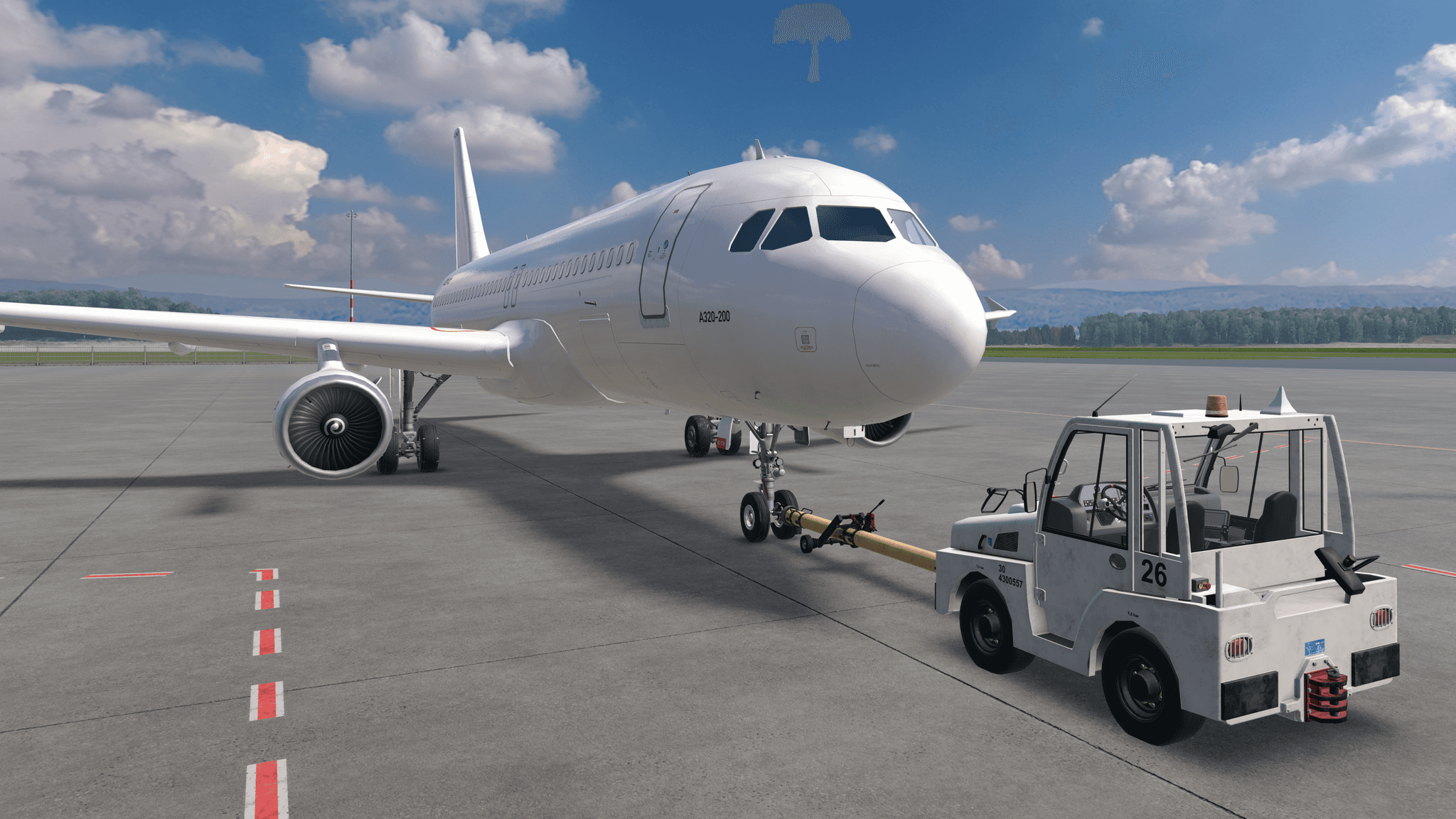
This lesson trains pushback driving through a progressive four-level system, from full steering guidance to fully independent operation across left curve, right curve, and dogleg scenarios. After each attempt, a scoreboard provides scored feedback on driving behaviour and target positioning. The training focuses on building steering control and path precision to prevent towbar overextension, jackknifing, and aircraft damage.
Lesson Overview
- 1Four training levels with increasing difficulty
- 2Practice steering with a guidance system to build familiarity with steering inputs and driving behavior
- 3Progress through all four levels, from guided to fully independent pushback
- 4Learn three pushback scenarios: left curve, right curve, dogleg
Skills Acquired
- Execute controlled pushback maneuvers to safely move an aircraft from the gate to the taxiway
- Understand the counterintuitive steering mechanics of a pushback with a towbar to maintain directional control through turns
- Recognize towbar angle limits at the nose gear and tractor connection to prevent structural damage and jackknifing
- Achieve precise final aircraft positioning on the taxiway centerline to ensure safe handover for taxi operations
Lesson Procedure
- The lesson starts with a training dashboard, showing four levels (Beginner, Intermediate, Advanced, and Expert) progressing from guided to fully independent driving.
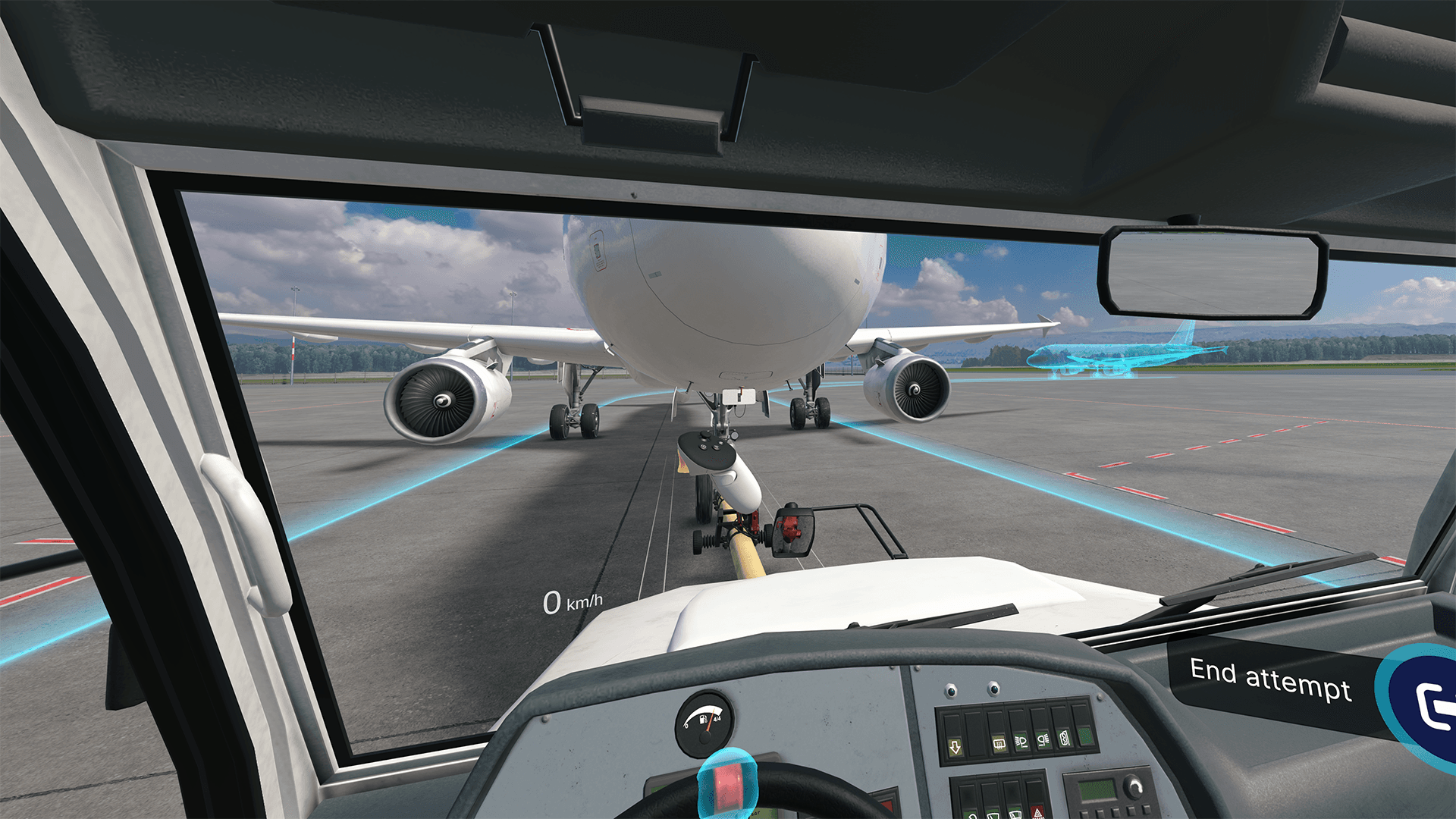
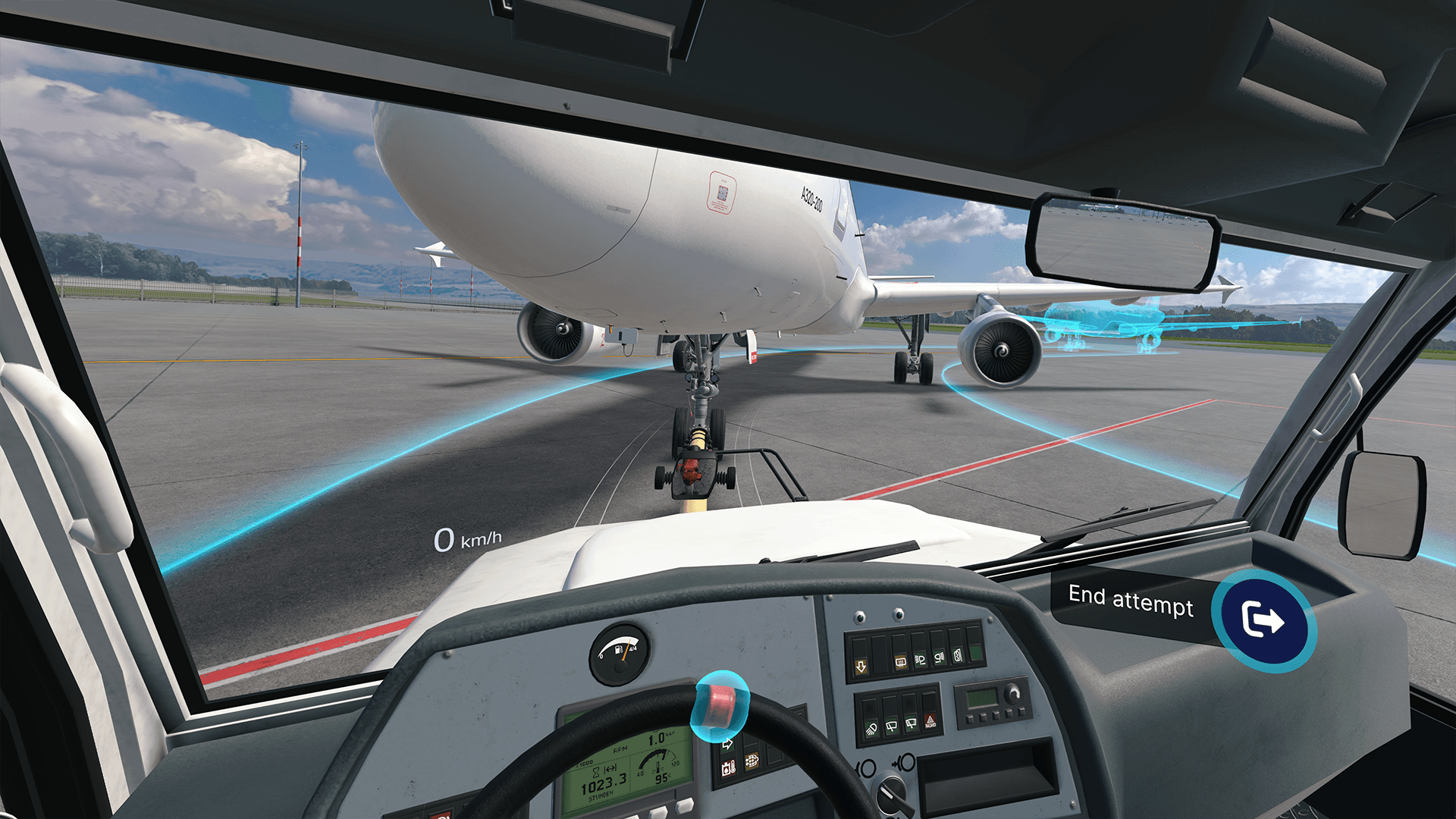
- A short tutorial introduces the guidance bubble mechanic: the trainee practices steering left, right, and back to neutral by centering the red steering indicator inside the blue bubble used to highlight the steering wheel target position.
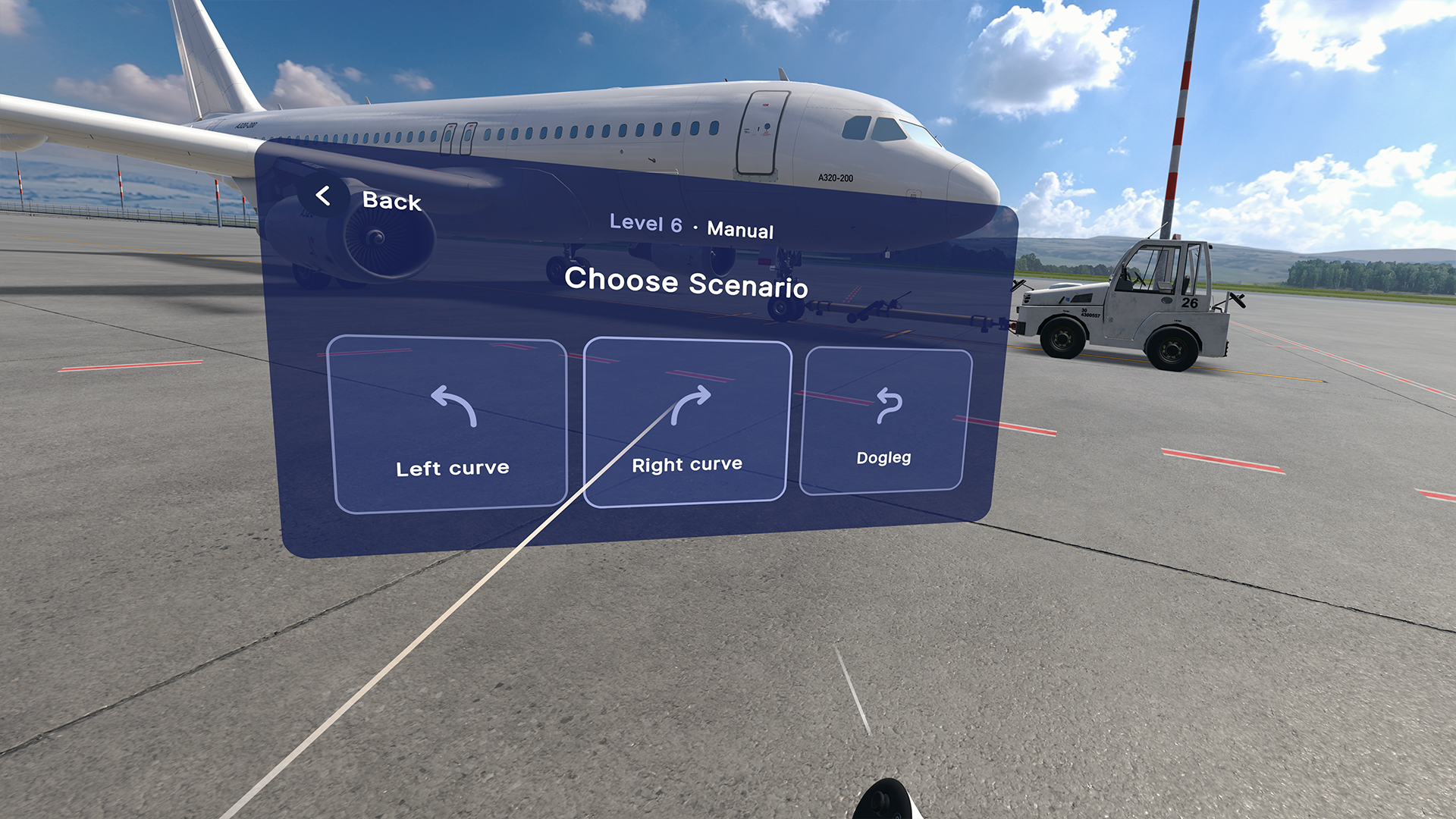
- The trainee selects a pushback scenario (left curve, right curve, or dogleg) and begins driving, following the highlighted path to the target position.
- In the first three levels, the guidance bubble appears progressively less frequently; the trainee adjusts steering inputs to stay on track and stop within the target zone.
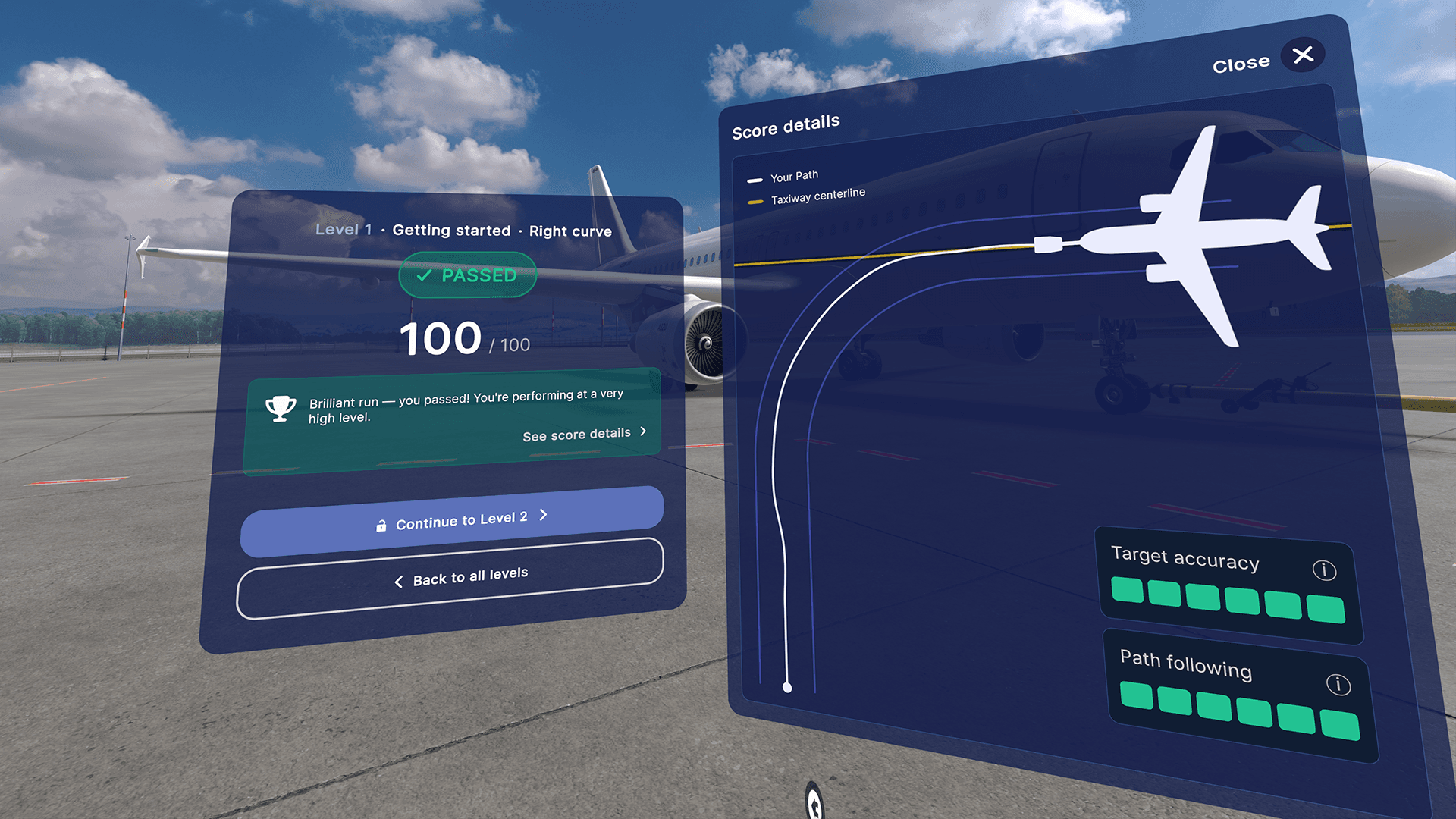
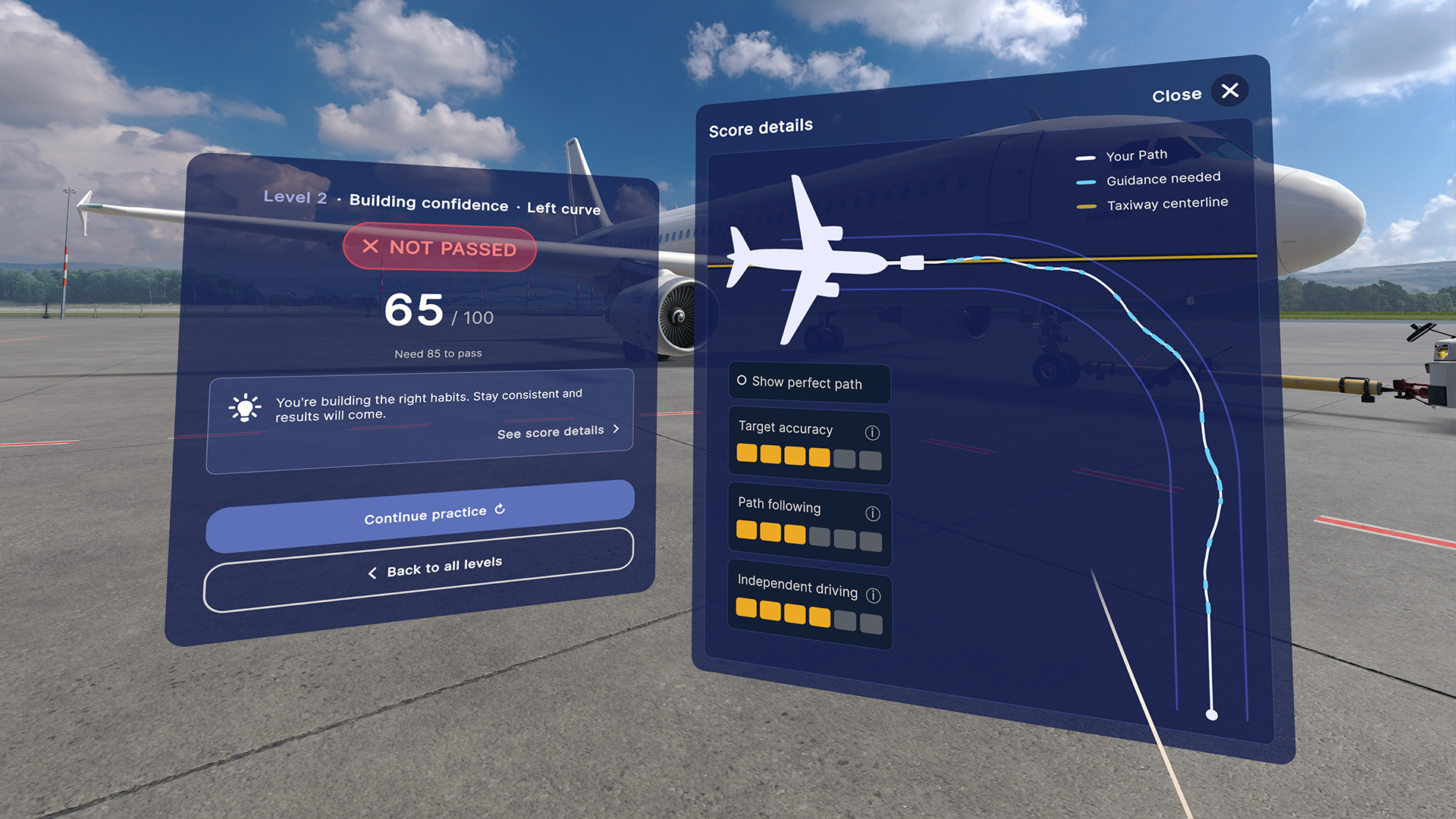
- After each attempt, a scoreboard displays performance across path following, target accuracy, and independent driving; a score of 85 or above is required to pass the level.
- In the Expert level, no guidance is provided; the pushback scenarios can be trained without any support in preparation for the Driving Exam lesson
Level Progression & Scoring
1. Beginner: Full Guidance
Trainees begin with continuous steering guidance. The focus is on understanding pushback motion, tractor response, and path control with full visual support.
2. Intermediate: Reduced Guidance
Guidance appears less frequently as trainees build confidence. Emphasis shifts towards developing directional control and independent steering decisions.
3. Advanced: Minimal Guidance
Near-complete independent operation. Trainees refine their technique with minimal assistance across all three pushback scenarios.
4. Expert: No Guidance
Trainees must pass at least one of the three pushback scenarios with a passing score to conclude the training. No guidance is provided, preparing trainees for the Driving Exam.
Scoring System
- Each attempt is evaluated and the score is displayed at the end of the attempt.
- A score of 85 or higher is required to pass. The score is calculated based on:
- Driving behaviour — measures pushback smoothness and steering control throughout the maneuver
- Target accuracy — measures how precisely the trainee positioned the aircraft and tractor at the final stop position
- Trainees who exceed steering limits receive a critical error, reinforcing the consequences of wrong driving decisions.
- The score detail view visualizes the driven path compared against the ideal path.
Safety Scenarios & Learnings
Towbar reaching the NO TOW zone at the nose gear
Attempt stopped; demonstrates that excessive towbar angle risks serious structural damage to the aircraft
Attempt stopped; demonstrates that excessive towbar angle risks serious structural damage to the aircraft
Tractor and towbar jackknifing
Attempt stopped; demonstrates that oversteering creates jackknife risk and can damage the equipment
Attempt stopped; demonstrates that oversteering creates jackknife risk and can damage the equipment
Driving off path
Attempt stopped; reinforces that path accuracy must be maintained during driving
Attempt stopped; reinforces that path accuracy must be maintained during driving